
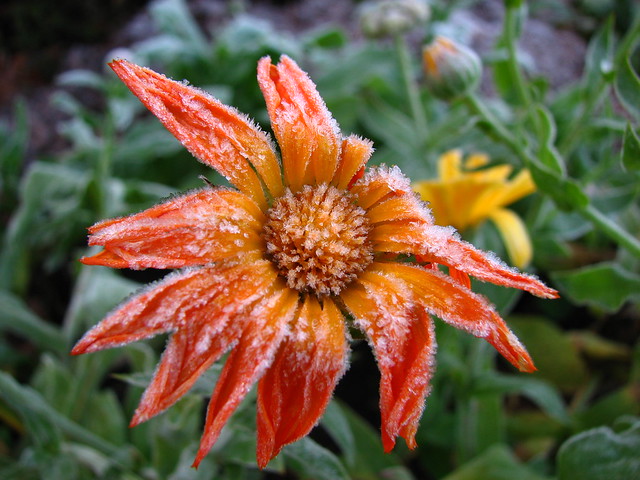
Fall has really just arrived. It is my second favorite season, which comes just before the worst – Winter. I do not really want to think about winter quite yet, but it will arrive soon for those in Northern areas. I did speak with a gardener in Colorado today who just received a forecast of snow within the week! So, it seems I am not too early to talk about this for some.
So when do you prepare for winter’s return? I always recommend waiting for the first light frost that makes your tender flowers wilt or flop before beginning cleaning up your beds and store any tender bulbs (bulbs which are not hardy in your zone). If it will better fit in to your schedule, feel free to perform these tasks earlier. I personally just prefer to enjoy my plants as long as possible before I make my beds look bare.
When light frost begins appearing, it is time to pull up your annuals, cut back all perennials to 3-4″ above the ground, and lift your tender bulbs for storing. This is especially important for those in US Hardiness Zones 2-7. If you are in one of these colder zones, you may also want to cover perennials with some mulch. Snow works as an insulator, but with freezing and thawing and little or no snow cover, your perennial roots can be destroyed. Bulbs that are hardy in your zone are deeper in the ground and do not need mulching.
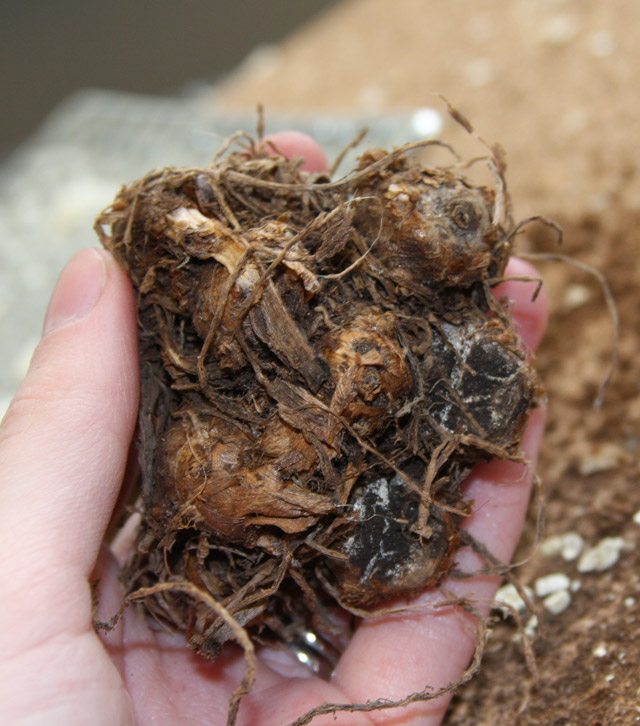
Caladium Bulb
For your quick reference, the most common tender rhizomes, tubers, corms and bulbs are: Dahlias, Cannas, Calla Lilies, Elephant ears, Begonias, Gladiolus, and Caladiums. These bulbs are only hardy in zones 8-10 or 9-10.
You could simply purchase new bulbs next year and allow the tender ones to die, but I like to be as frugal as possible. Storing tender bulbs is very simple and takes just a little effort.
- Start by trimming foliage to ground level
- Carefully dig around bulb and lift
- Shake and gently wipe off as much dirt as possible (do not rinse)
- Let dry for 1-2 weeks in a cool, dry area that will not freeze
- If storing more than one type of bulb, don’t forget to sort and label
- Once dried, shake off and remove remaining dirt
- Find a container to store them in such as a cardboard box, paper bag, basket, etc
- Use peat moss, wood shavings or vermiculite to keep bulbs separated and well hydrated
- Keep your stored bulbs in a dry, cool (45° to 55°), dark and ventilated area until spring
Now that you have taken care of your garden – go relax. Maybe you can enjoy an autumn bonfire like me!











My son gave me a vase of the tulips that bloom by keeping the roots under water
(no dirt used)
They were BEAUTIFUL and lasted over a week.
Now I have dead flowers and want to save the blubs to hopefully rebloom next year.
Can you tell me how to protect the bulbs now and how to get them rooting and ready to go next year ?
Im glad you enjoyed them! BUT when you force bulbs, you generally will have no luck at keeping them. The leaves need to soak up sun to rejuvenate the bulb and then “hibernate” and then begin the growing process all over when the cold months begin. The rejuvenate process does not usually happen when you force the bulbs. It really is like having fresh cut flowers.
Sorry!
My daughter gave me a tulip plant that had been potted. The flowers are gone and the foliage is starting to fade. Can I repot the bulbs or should I dry them and save to plant later. I live in FLorida in zone9-10.
Stop watering. Once foliage is completely dried out store bulbs in a dark cool (below 60°) area. Then after 4-5 months you can bring out to water and light again. Tulips need ‘down time’ and approx 15 weeks of COLD to grow and bloom properly. see blog post: Forcing Flower bulbs
I live in the Central Florida area. I was repotting flowers and came across the tulip plant given to me a month ago. The foliage is gone, but digging in the plant, we found the bulbs – many of them. It never gets really cold here, so how should I care for the bulbs that we got from the plant?
Can I put them in the refrig or freezer and then bring them out when it gets cool – probably not until late October?
Tulips are only hardy into USDA zone 7. So, if you are warmer than that, keep in soil but do not water. I would wait at least until June before putting them in cool area like a refrigerator. They are not like seeds and they can dry out. You would need to force them to get them to grow again. For directions see my post: Forcing Flower Bulbs
When do I take up tulip bulbs so that I can seperate the bulbs and then when do I replant them.
After foliage has completely yellowed and died back, you may dig up for replanting. Bulbs are now rejuvenated and need to ‘rest’ a while until temps cool down again. PS:Do not water when replanting.
Hi — A New York City gardener has just given me tulip bulbs taken from the soil May 3rd so annuals can now be planted in the tree wells. I would like to care for the bulbs, let the leaves dry, and then let the bulbs “hibernate” so they can be replanted in terrace and/or house pots for next Spring’s blooming. They are beautiful blooms and well worth nurturing. What are the steps you suggest I follow? I have no outdoor space of my own. Thank you!
Nora,
If the tulips were done blooming and foliage had completely yellowed- then you would now store them in a cool dark place, until its time to really chill them for forcing. See: Forcing Flower Bulbs.
But it sounds like they were still green and removed from ground- which means the bulb roots are damaged and the leaves will not be able to rejuvenate the bulb. Which means- throw them away- they will produce nothing next year except maybe a leaf or two. Sorry 🙁
Hi Gabrielle — Thanks so much for answering. The bulbs were taken out with a lot of soil around the roots, and I hoped that by re potting them for a while till the leaves do die back I could save them to replant. I wondered since I do not have an outdoor space, if I did dry the bulbs after the leaves have dried, yellowed and then been removed, when I should re pot them in order to hopefully have them bloom in their normal time next spring. Or, do you think there just too much wishful thinking here? I’m happy to try if there’s a chance of some blossoms, I don’t expect a guarantee. Thanks again!
Hi, I just today may 26th dug up my tulip bulbs. the foliage was yellow and dead. I only had 8 blooms but when I got to digging I found over 50 bulbs. I have them from pea size to golf ball size. I have them on an old sheet open to the air. What do I do now??? I never did this before. Thanks
Kathleen,
Bulbs will naturalize (reproduce). Those bulbs that are smaller than 10-12cm in diameter will not flower. It will take a few years for them to mature.
Why did you dig up? to move to new area? You can replant if hardy in your zone (colder than zone 8). If not, you can store in cool dark place until later. You can also look at my other post: Stunted and dissappearing Tulips. Hope that helps!
I dug them up to place them all together in a tulip garden of their own. Thanks!
The professionally landscaped planters at my Chicago office complex offered tulips bulbs to those who wanted to dig them up. The tulips bloomed and then stayed in the planters until all the leaves and stems naturally dried. I have a paper bag of about 50 bulbs. Should I plant them in my yard now or somehow store them until Oct./Nov.?
You can plant them now outdoors-try not to water them. They will probably have a better chance in the ground 6inches deep, then they would all together in a bag for that long.
Hi, My husband and I went to Amsterdam last May and we ordered bulbs to be delivered to us for fall planting in NJ. Well, it is now November 28th and the bulbs just got here. What do we do now? Is it o.k. to plant them or do we store them till the spring? and if we need to store them, how do we do it?
Ordering straight from the farm! Awesome, except I assume you paid alot in shipping! TulipWorld imports them directly from Holland in bulk(of course). If you decide to order more Holland bulbs in the future, they probably would get them cheaper for you.
Anyhow… The need to be planted ASAP. If your ground is not frozen, get them planted. Otherwise, you are left with having to ‘force’ them. (You can see my post on forcing.) They cannot simply be stored until spring or next fall. They would rot or dry out before then.
I hope this helps. If you come up with more questions- check back with me!
Sincerely,
Gabrielle
I received a tulip in a small pot as a gift. The leaves are now yellowing. I am a little confused by some of the posts, so forgive me if I am posting something already asked and answered. I do not have a yard to plant it in, so do I put the bulb in a bag now, keep in the frig til ? Do I need to add anything to the bag during this time?
Thanks.
If you really want to keep it… Once it has totally dried & yellowed, leave in pot and do not water. keep in cool, dark area for at least 3 months. Then take bulb (in or out of pot) and store in refrigerator for 15 weeks. Then you may take out(replant if needed), start watering as needed. 2-3 weeks it MAY grow.
Someone gave me some potted, blooming tulips in January. What should I do with the bulbs now? Store them or plant them? (I do not have a yard, but my windows are lined with potted plants, so they will be kept indoors.) Thanks!
You can try to keep them.
Keep them watered until leaves turn all yellow. Then, once soil has dried out, place pot or just bulbs in cool dark place for at least 3 months. “Forcing” is what you will be doing, because Tulips, Daffodils, etc all need 12-15 weeks of cold to bloom. See my other post on forcing flower bulbs: http://www.flowerbulbcrazy.com/forcing-flower-bulbs/
My tulips came in a glass cylinder vase with waster (no soil) & they bloomed beautifully. Do I cut off the blossoms & leave then in water & sun until the leaves turn yellow or die down, or do I cut the stems off & dry the bulbs out. I understand after they dry, I can store them in the refrigerator. I live in mid-Florida. I understand they can ne stored there for 15 wks. before planting. Can I store them longer in the refrigerator before planting?
Judy,
Because they grew in no soil, your chances are lessened to get them to regrow next spring. You can always try…
You would not cut back and store/plant until leaves have completely yellowed.
Do not suggest storing longer. The longer they are out of the ground/soil, they can begin to rot or dry out.
It may be less stressful buying new tulip bulbs this fall/winter 🙂
I have read the various posts about replanting bulbs but want to be sure I do it correctly so I don’t lose my beautiful tulips. I live in Zone 6 and my plants are outside.
I am thinking of pulling the bulbs so I can see if there are other bulbs attached that I can plant in another location. Since they were all planted at the same time I am assuming that any attachments will be the same size. Do the attachments need to be as large as the original bulb before they are detached? Once I detach, can they go directly into the ground in the new spot? All this needs to be done after the foliage has completely yellowed, right?
After completely yellowed, you may dig up, separate and move. It can take several years for the new bulbs to be big enough to produce flowers.
Have you seen extra leaves coming up with the original tulip, to make you think they have naturalized? I would be surprised if you did. Zone 6 typically is not ideal for tulips. Tulips come from mountainous hillsides. The closer your conditions are to its natural habitat, they more likely to reproduce and continue to return each year. (Harsh winters, dry summers and excellent drainage.)
Wish you the best!
Hi!
Every year my city has an annual tulip pull. It’s right after the first weekend in may. These bulbs are premium and gorgeous! You should see them bloom around the city. They are something that our area is known for. Anyway, I have a bag full, they still have their greenery attached, for the most part. What should I do with them to have them bloom next year? Should I replant them in a bed till their greenery falls off and then dry out the bulbs? Someone told me to let them dry and then I can freeze them. Is that true? I would really like to know because I want my garden to look as lovely as my town in mid-April. I don’t know what zone I live in, but I live in Delaware. Please let me know. Thank you!
You can try your best. Generally you never move/pull up a bulb until greenery has completely yellowed. The greenery rejuvenates bulb so that it will bloom the next year.
I have received tulip bulbs which need to be stored until September when they can be planted. How do I preserve these bulbs until fall planting?
Thank you.
Tulips are generally harvested in July. Must be kept cool, dark and ventilated until able to plant. They cannot be stored well over 6 months. You can plant them before fall unless you are in zones 9-10.
hello gabrielle, I like to plant annuals where my tulips & daffodils are.But if I wait until the leaves turn yellow to cut them back,I have no color for weeks.What’s up with that?!What do I do?Plus,I dug up some daffodil bulbs(already died back)and put them in a paper bag in some peat moss in a cool dry place until fall, like the garden guy told me to do.Is this O.K. and when do I plant them?I live in Conn.Thanks so much Rick D.
If you left space in front of the bulbs- that is where i would plant the annuals or plan to have room to plant the annuals. Why did you dig up your daffodils? They are hardy into zone 7. They do better being left in the ground. Otherwise, as long as you keep bulbs cool, dark and ventilated, they can last 4 months out of the ground.
I had to dig up some tulip, daffodil and allium bulbs that had been in the ground for about 4 years in my zone 2 garden in Canada because I put a garden path in my garden which went through a patch of these flowers. The bulbs had flowered but not completely yellowed yet. Should I replant them right now or store them to plant in the fall? I kept all the foliage when I dug up the bulbs yesterday and they are still in the dirt that came up with them. They are in a cardboard box in my garage.
Thanks for your help.
Liz
Sorry for late response- went on vacation.
Plant asap. If roots and foliage haven’t been damaged much, you will be successful. If they were, I would buy new bulbs this fall to replace them.
Gabrielle,
Thank you so much for replying. I was going to save them till the Fall, so I’m really glad that you advised me to plant ASAP. They should be fine, lots of roots on the bulbs and all the foliage was intact. Your web site is a great resource. Thanks again!
Liz